




AI + Project Management, The Future Is Here
Make project management seamless, interconnected, once-and-for-all, and fully transparent.
Amidst the fierce competition and electrification transformation in the automotive parts industry, enterprises are facing challenges such as project delays, cost overruns, quality risks, and inefficient cross-departmental collaboration. Jumitech's Automotive Parts R&D & Manufacturing Project Management System deeply integrates advanced project management methodologies including APQP/PPAP quality processes, IPD R&D concepts, and TOC (Theory of Constraints) critical chain. Through a task-driven, data-connected digital platform, it helps automotive parts enterprises achieve full-process project visualization, optimal resource utilization, and traceable quality, completely eliminating information silos and progress black boxes.
With the core goal of "a visible, manageable, and retainable project management platform", the platform is committed to helping automotive parts enterprises achieve integrated collaborative management of project plans, quality, costs, resources, and risks, and improve project delivery success rates. Making project delivery faster, more cost-effective, and more reliable — this is the next-generation core competitiveness we help you build. We create a cross-regional, cross-organizational project collaboration platform for automotive parts enterprises; a visible, manageable, and retainable project management platform; an efficiency improvement platform for project communication, collaboration, and control; a data integration platform for the entire project process and full-factor management; and an ecological cooperation platform that connects and empowers project participants, realizing organizational online, communication online, collaboration online, business online, and ecology online for automotive parts enterprise project management.
In the past, the industry generally believed that the integrated model of "PDM + PM = PLM" was the ultimate answer. However, our observations have found that many large customers using mainstream foreign PLM systems often fail to achieve the expected results with their project management modules, and ultimately have to abandon them and switch to independent professional project management systems (PMS), which are then integrated with PLM to achieve collaboration. This phenomenon reveals a new trend: as enterprises' requirements for project management depth, flexibility, and professionalism continue to increase, the PM functions of general-purpose PLM can no longer meet complex needs. The market is experiencing a rational return: from pursuing "large and comprehensive" integration to embracing the "professional and refined" best combination. This has created enormous value for solutions that can seamlessly integrate PDM and collaborate with professional PMS.
Jumitech's project management system fills this gap. It has served a number of well-known customers in the fields of product R&D and manufacturing based on APQP or IPD, and R&D and manufacturing of whole vehicles and parts molds, including Fuyao Group, Minth Group, SAIC-GM, SAIC Z-ON, Great Wall Honeycomb Drivetrain, Great Wall Precision Auto, Bicom Optics, etc.
Enterprises with global business coverage that need a unified platform to achieve multi-factory, multi-project, and multi-language management.
Suppliers who need to strictly follow OEM APQP processes and are required to have digital project management capabilities.
With the expansion of business scale, enterprises urgently need to transform from a project management model relying on personal experience to a standardized, process-oriented, and digital management model.
Enterprises that hope to break information silos, realize the connection of project data with ERP, PLM, MES and other systems, and drive efficient business collaboration.
Project data is scattered across multiple independent systems such as PLM, ERP, CRM, and OA, forming data gaps that make it difficult to control the overall situation.
Multi-level plans (master plans, department plans, supplier plans) are disconnected, progress feedback is delayed, and the real progress is "invisible".
APQP phase deliverables and quality gate reviews rely on offline Excel and emails, with opaque processes, difficult traceability, and high pressure from customer audits.
The human resource pool is unclear, resource conflicts between projects are serious, and the workload is uneven, affecting the progress of key tasks.
Project budgets are disconnected from actual costs, the impact of changes on costs cannot be evaluated in real time, and cost overrun risks are discovered late.
Experience and lessons learned during the project have not been effectively accumulated and reused, and the phenomenon of "repeating mistakes" is common.
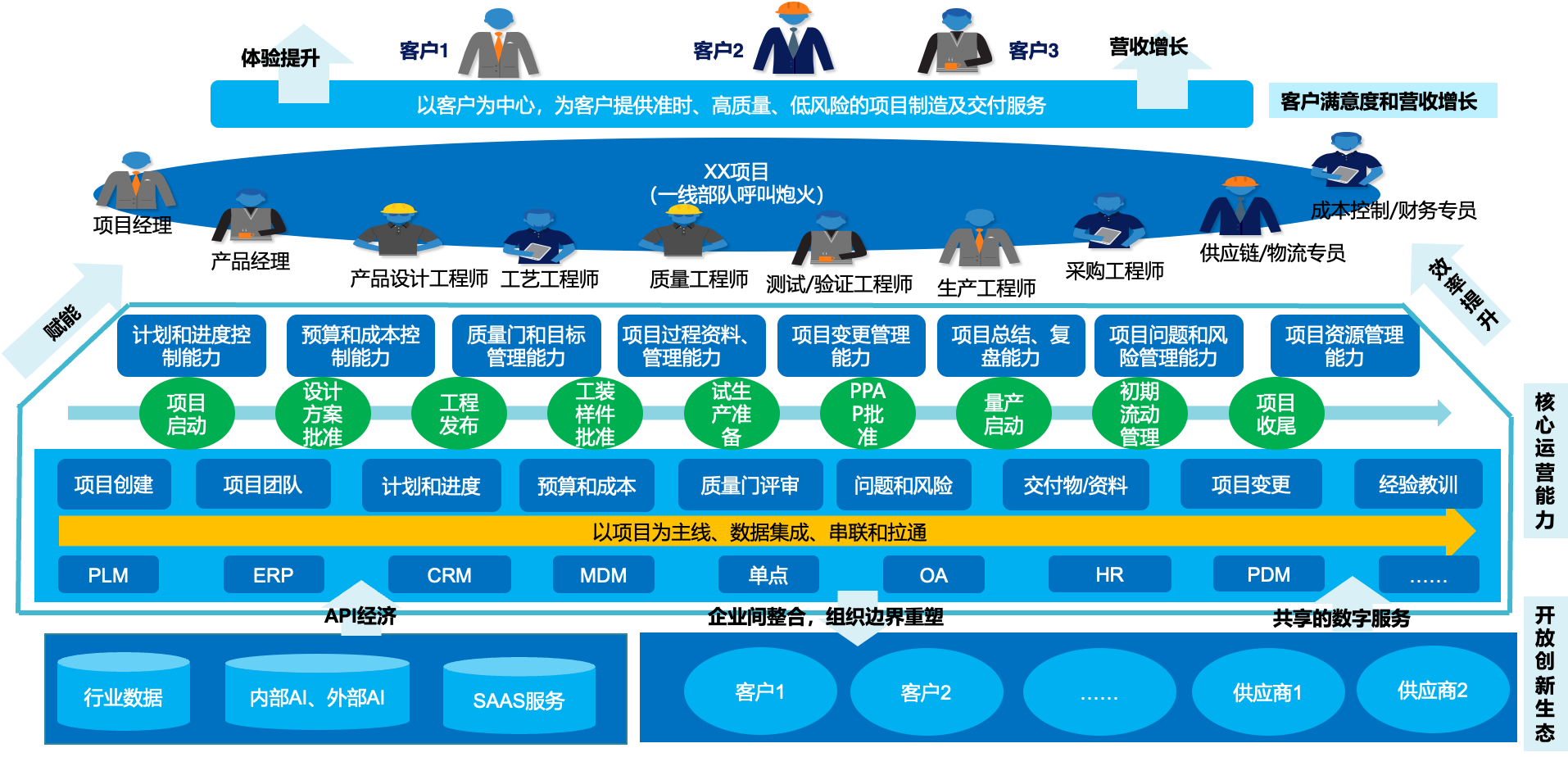
Empower project managers, product managers, product design engineers, process engineers, quality engineers, test and verification engineers, production engineers, procurement engineers, supply chain/logistics specialists, and cost control/financial specialists to enhance collaboration across organizations, departments, and professions.
Build capabilities in plan formulation and progress control, budget and cost management, quality gate and target management, project process documentation management, project change management, project summary/review, project issue and risk management, and project resource management.
Through the restructuring of enterprise organizational boundaries and sharing of digital services, customers and suppliers can be integrated into the platform to form an ecosystem and an open innovation ecosystem.
Customer-centric, providing customers with on-time, high-quality, and low-risk project manufacturing and delivery services to help the company achieve revenue growth.
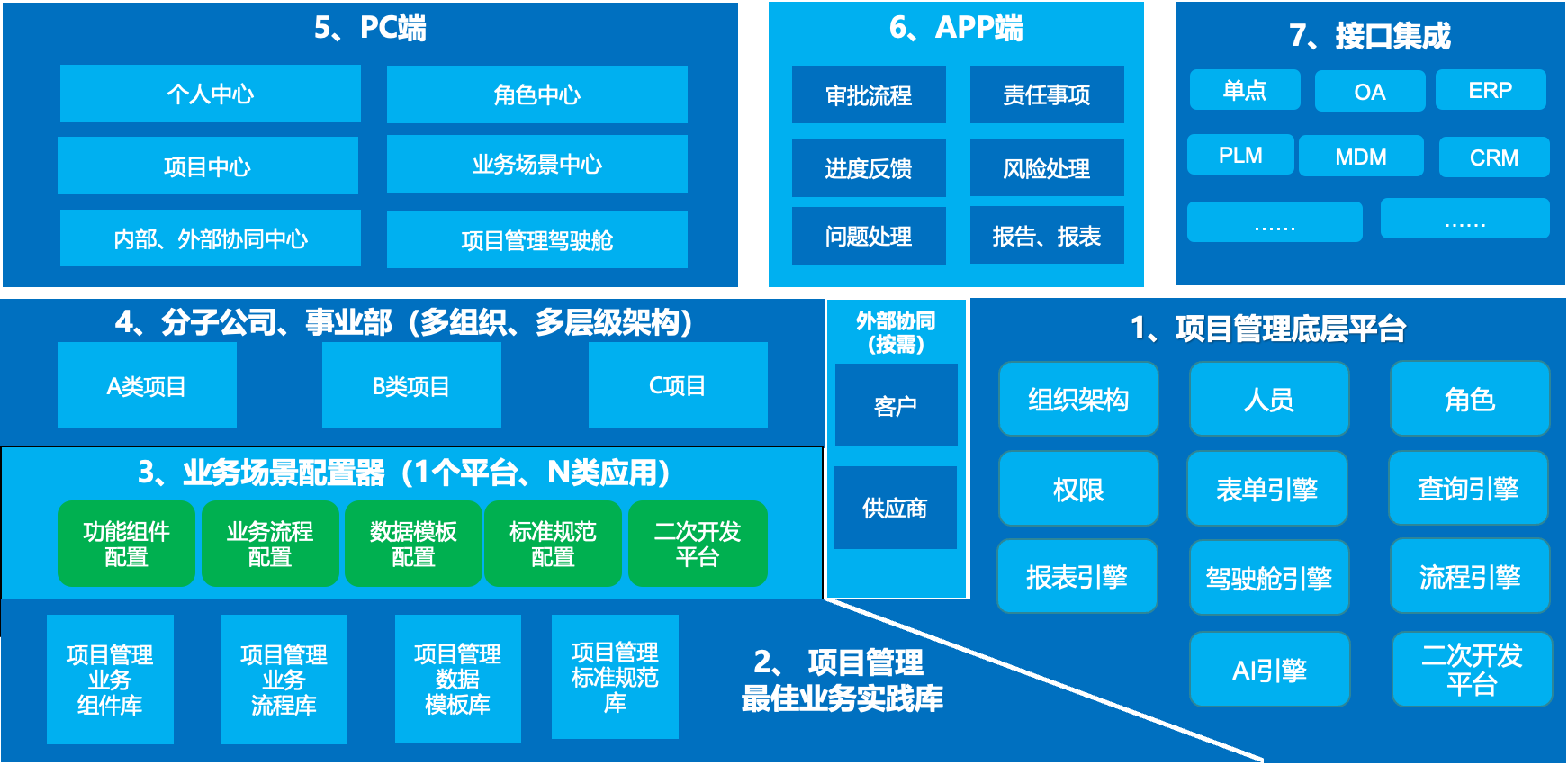
The platform adopts private deployment and multi-tenant architecture. Project participating units can be incorporated into the platform through enterprise registration and review to collaborate and complete project delivery.
Including business component libraries, business process libraries, data template libraries, and standard specification libraries for different project types in the automotive parts industry.
Configure different business components, business processes, data templates, and standard specifications for different project types. If insufficient, extended development can be carried out through the extended development platform to achieve "one platform, N types of applications".
Portal, PC terminal, APP terminal, and interface integration with third-party systems, including personal center, role center, business center, collaboration center, and project center.
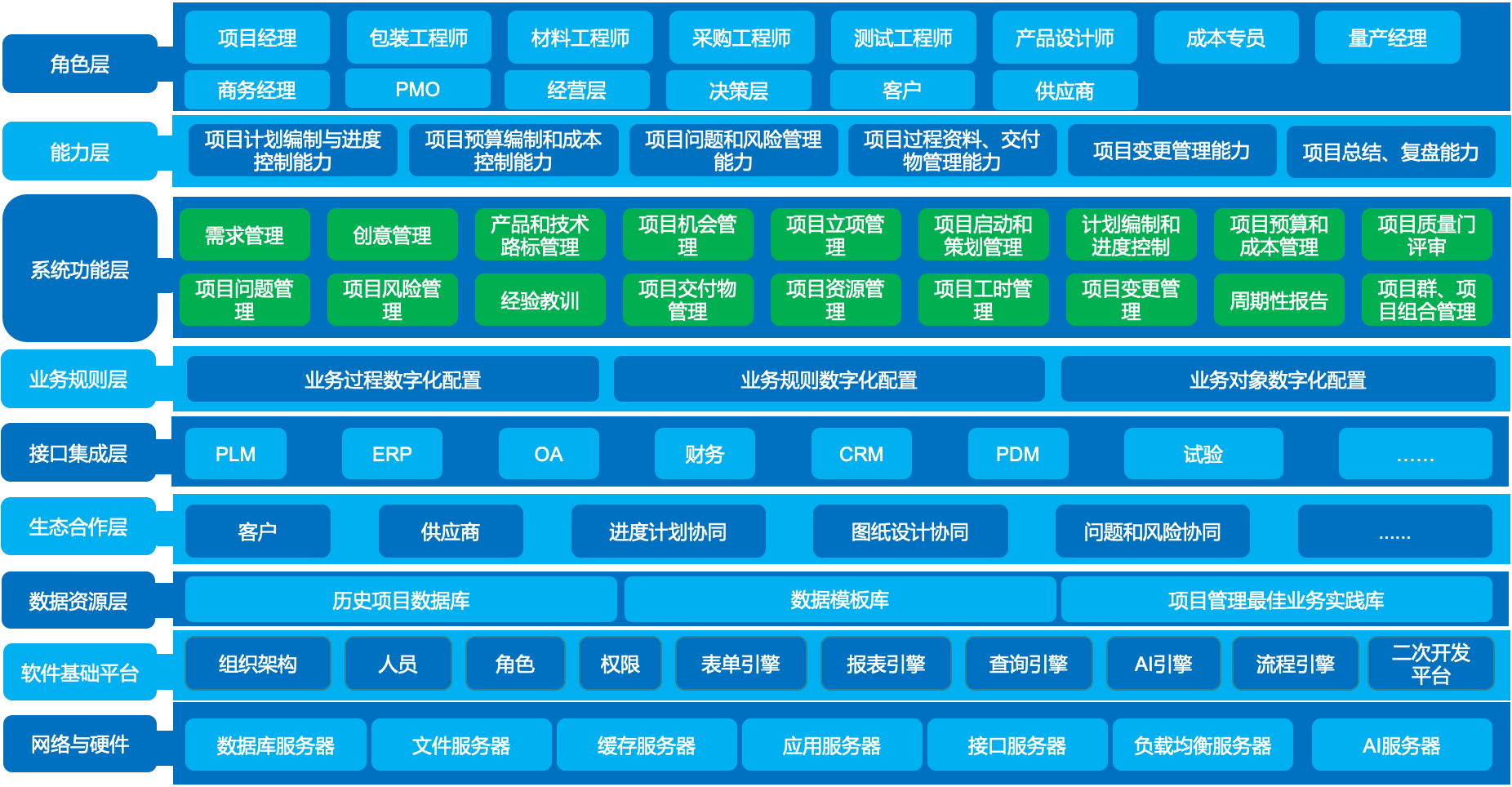
Project manager, packaging engineer, material engineer, procurement engineer, test engineer, product designer, cost specialist, mass production manager, business manager, PMO, management layer, decision-making layer, customer, subcontractor.
Project initiation and planning capabilities, project plan formulation and progress control capabilities, project budget formulation and cost control capabilities, project issue and risk management capabilities, project process documentation/deliverable management capabilities, project change management capabilities, project resource management capabilities, and project summary and review capabilities.
Project opportunity management, project approval management, project initiation and planning management, project plan and progress management, project budget and cost management, project quality gate review management, etc.
Digital configuration of business processes, digital configuration of business rules, digital configuration of business objects.
CRM, SRM, ERP, MES, PLM, TMS, OA, PDM, financial systems, etc.
Customers, suppliers, schedule collaboration, drawing design collaboration, procurement and supply collaboration, issue and risk management collaboration.
Historical project database, data template library, project management best practice library.
Organization structure, personnel, roles, permissions, task activity engine, form engine, report engine, query engine, AI engine, process engine, secondary development platform.
Database server, file server, cache server, application server, interface server, load balancing server, AI server.
Through project management cockpit, digital dashboard, and automated periodic reports, enable decision-makers and managers to have a comprehensive view of the progress, costs, quality gates, issues, and risks of single projects, multiple projects, project portfolios, and project programs.
Based on goal management and cybernetics, achieve effective control of project plans and progress, budgets and costs, quality gates, changes and visas, and monitor and alert project progress, costs, quality gates, documents, issues, and risks.
Through three databases - the ongoing project database, the historical project database after project closure, and the project management best practice library summarized and refined, achieve the accumulation and reuse of project data.
Project participants conduct online discussions and communications on business objects such as progress, costs, deliverables, and changes, including text, files, emails, etc. Communication process records are permanently stored.
With projects as the main line, plans as the leader, and tasks as the driver, through critical chain project management, identify business bottlenecks, resolve blockages, increase project flow, and achieve orderly and efficient collaboration across organizations and departments.
Through hierarchical and layered plan management, rolling plans, interface plans, PDCA cycles for quality and safety, and project document control, transform the transmission of data and information from traditional offline to online, effectively improving the efficiency of project control.
Essentially, the project management system is a system that takes projects as the main line, integrates, connects, and aggregates data with the enterprise's existing IT systems. The core task is to "guide and coordinate with projects as the main line, drive with tasks, and realize the transmission and flow of project data and information across various professional systems according to project phases and tasks, avoiding information silos and improving collaboration efficiency." These systems include: CRM system, ERP system, MDM system, OA system, BPM system, PLM system, financial system, test system, prototype system, inspection system, change system, budget system, WeChat Work, DingTalk, Feishu system, etc.
Taking projects as the carrier and portals as the entrance, integrate upstream and downstream industrial chain enterprises (such as customers, accessories, molds, etc.) into the platform. Through enterprise registration and entry, move from internal collaboration to external collaboration, and build an ecological circle. External collaboration business scenarios include: cross-organizational multi-level plan formulation and progress control, online document collaboration, online quality issue and risk management, online change management, etc.
Customers such as Fuyao Aluminum Parts, Fuyao Auto Glass, and Honeycomb Drivetrain have established project plan formulation and progress control systems, significantly shortening project cycles.
Customers such as SAIC Z-ON and SAIC-GM have established refined project cost management systems, reducing individual project costs by more than 5%.
Through APQP process electronicization and quality gate reviews, ensuring high-quality product delivery and improving quality management levels by 15%.
Achieving full-process cross-departmental collaboration and cross-organizational collaboration with all project participants, improving overall collaboration efficiency.
Providing customers with on-time, high-quality, and low-risk project manufacturing services, and opening the project management platform to customers.
| Function Module | Function Module Description |
|---|---|
| Requirement Management | Requirement collection, requirement analysis and sorting, requirement distribution, requirement implementation (associated with projects), requirement verification, requirement traceability matrix. |
| Idea Management | Manage potential idea library, alternative idea library, and effective idea library; manage the review and transformation process from potential ideas to alternative ideas, and from alternative ideas to effective ideas. |
| Product and Technology Roadmap Planning | Technology element maintenance, product platform maintenance, product line maintenance, product maintenance, product and technology roadmap planning (associated with projects). |
| Project Opportunity and Pre-approval | Project opportunity, business case, pre-approval team, pre-approval review, execution of follow-up tasks after pre-approval. |
| Project Creation | Project numbering rules, project creation, project information adjustment, docking with MDM system. |
| Project Initiation and Planning | Project manager appointment, project team member maintenance, project handover, project kick-off meeting. |
| Project Objectives and Feedback | Project objective templates, project objective preparation and approval, actual project objective feedback, comparative analysis of project objectives and actual results. |
| Project Plan Formulation and Progress Control | Standard task library, plan templates, preparation and approval of key milestone plans, master control plans, and special plans, multi-level plan linkage, task push, task execution and feedback (deliverable-driven, business form-driven, other IT system data-driven, lower-level plan-driven), progress monitoring and early warning, plan adjustment and progress assessment. |
| Project Quality Gate Review | Quality gate review templates, quality gate creation, quality gate review process management (task triggering, association with target completion and deliverables, traffic lights, issue rectification, release, etc.). |
| Project Budget and Cost Control | Project expense items, project expense worksheet templates, definition of project expense items and project expense worksheets, preparation and approval of project budgets (target costs), collection of actual project costs, early warning of project cost overruns. |
| Project Document (Deliverable) Management | Project document directory and document templates, task deliverable templates, drafting, approval, filing, query and retrieval, authorization, download, and version management of project documents, online document co-editing, project document control list. |
| Project Issue Management | Raise, resolve, and close issues, issue lists, conversion of issues to risks, and accumulation of issues as lessons learned. |
| Project Risk Management | Risk list templates, risk identification, risk monitoring, risk elimination, early warning settings for schedule delays, cost overruns, personnel overload, and quality risks. |
| Project Change Management | Change intention, change application, internal approval of changes, external approval of changes, notification and implementation of changes, verification of change orders, closure of changes, project personnel changes, project plan changes, project budget changes, project change history sheet. |
| Project Resource Management | Enterprise resource pool, project resource pool, project resource requirement planning, resource application, resource allocation, resource outsourcing requirement processing, resource renewal, resource usage records (time reporting), resource release, resource load analysis, resource performance reports, work handover. |
| Project Time Management | Personnel rate maintenance (sensitive data encryption), working hour parameter settings, leave, personal daily reports, working hour filling, working hour confirmation, working hour statistics, labor cost statistics and collection, working hour query. |
| Lessons Learned Management | Lessons learned horizontal expansion matrix, accumulation and approval of lessons learned, horizontal expansion of lessons learned, query of lessons learned library, intelligent push of lessons learned. |
| Project Closure Management | Project closure checklist, project closure. Status management of project initiation, suspension, termination, etc. |
| Program and Portfolio Management | Program and portfolio definition, project priority ranking, program and portfolio data analysis. |
| Project Periodic Reports | Definition of periodic report elements, setting of periodic report templates, automatic generation, sending, and viewing of periodic reports. |
| Project Management Cockpit | Overall dashboard, multi-project/program dashboard, portfolio dashboard, single project dashboard, project progress dashboard, project cost dashboard, project deliverable dashboard, project resource dashboard, project change dashboard, project issue dashboard, project risk dashboard. |
| Business Component Library | PC-side business components, APP-side business components, custom component library, project progress management business components, project cost management business components, project quality management business components, project document management business components, etc. |
| Business Process Library | Business process drawing, business process release, project delivery visualization, data flow automation, project delivery bottleneck identification. |
| Standard Specification Library | Classification of standard specifications (national, industry, enterprise), upload of standard specifications, query and retrieval of standard specifications, borrowing of standard specifications, cancellation of standard specifications. |
| Historical Project Database | Databases of historical project progress, costs, quality, issues, risks, working hours, documents, etc., query, retrieval, and reuse of historical project data. |
| Data Template Library | Project team role templates, project standard task library, project plan templates, expense item templates, project deliverable templates, project quality gate review templates, project objective templates, etc. |
| APP Terminal | Pending approvals, responsible matters, message notifications and early warnings, task push, progress feedback, issue and risk handling, viewing of project reports and statements. |
| AI Empowerment | AI-assisted project approval, AI-assisted preparation of plans, budgets, and deliverables, AI-assisted deliverable review, AI-assisted project health check, risk identification. |
Jumitech has long been committed to the research of project management theories and practices. We have deeply insight that the application of AI in project management is evolving from a tool to a partner, and even to a strategic core:
ChatBots: Natural language dialogue. Automate repetitive tasks and free up human resources.
Reasoners: Basic reasoning and question answering. Provide data analysis and preliminary suggestions to assist decision-making.
Agents: Execute tasks on behalf of users with independent action capabilities. Deeply participate in processes for real-time collaboration and reminders.
Innovators: Participate in invention and creation to enhance human creativity and innovation capabilities. Provide professional-level management suggestions and solutions in specific fields.
Organizations: Undertake the entire organizational function to independently manage and execute complex operations. Conduct resource coordination, strategic alignment, and effectiveness evaluation from an organizational-level project management perspective.
Jumitech XPM+ platform deeply integrates artificial intelligence technology to create an intelligent application matrix covering the entire project lifecycle. The following are detailed explanations of the core AI functions that have been implemented:
Use natural language processing and machine learning models to conduct multi-dimensional intelligent evaluation of project proposals, analyze strategic compliance and potential risks, provide data-driven project approval for decision-makers, and improve investment success rate from the source.
Based on historical project data and industry best practices, it automatically generates a first draft of a project plan with a rigorous structure and reasonable task decomposition, embedded with intelligent scheduling logic, significantly improving the efficiency and scientificity of planning preparation.
Acting as a "senior planning expert", it intelligently identifies logical conflicts, resource overload, and critical path risks in the plan, and provides specific optimization suggestions to ensure a robust and reliable project baseline.
Build a dynamic "resource smart brain" to monitor resource load and skill matching in real time, simulate the impact of different scheduling schemes, and recommend optimal solutions to maximize resource utilization.
By analyzing historical cost structure and market data, it quickly generates detailed and reasonable budget drafts, improving the accuracy of cost forecasting and reducing the blindness of budgeting.
Automatically detect outliers and potential over-fulfills in the budget, propose cost optimization plans through multi-scenario simulation, and strengthen project cost control capabilities.
According to project types and industry specifications, standardized document catalog frameworks are intelligently generated with one click to ensure the standardization and integrity of project document management.
Intelligently generate high-quality first drafts of key deliverables based on project tasks and knowledge assets, freeing up the productivity of project members and allowing them to focus on creative work.
Preset quality standards, automatically verify the consistency and integrity of deliverables, quickly identify errors and omissions, and act as the first intelligent quality checkpoint.
Deeply integrate speech recognition technology with project management scenarios, and the spoken content can be automatically converted into structured reports, revolutionizing the efficiency and experience of information entry.
In mobile office scenarios, update task progress in real time through voice, and automatically synchronize information to the system, ensuring seamless collaboration and real-time accuracy of data.
Automatically aggregates project data according to preset periods and generates professional reports with pictures and texts within seconds, allowing managers to grasp the overall picture of the project at any time and with one click.
Create a "talking" project database that supports natural language questions (such as "Project A's cost deviation rate this month?" Get accurate answers instantly and democratize data.
Visualize complex data relationships and automatically generate the most suitable charts (such as burndown charts and resource bar charts) according to instructions, allowing you to understand the project status at a glance.
Serve as the "intelligent physical examination center" of the project, continuously monitor key indicators, quantify health scores and proactively identify risks, provide root cause analysis and response suggestions, and achieve a leap from passive response to active management.